
Not every skin type needs the same kind of facial treatment.
Someone with oily, congested skin may want help with excess oil and clogged pores, while someone with dry skin may be more concerned about dehydration, rough texture and loss of radiance. Sensitive skin brings another consideration: the treatment needs to be gentle enough to avoid unnecessary irritation.
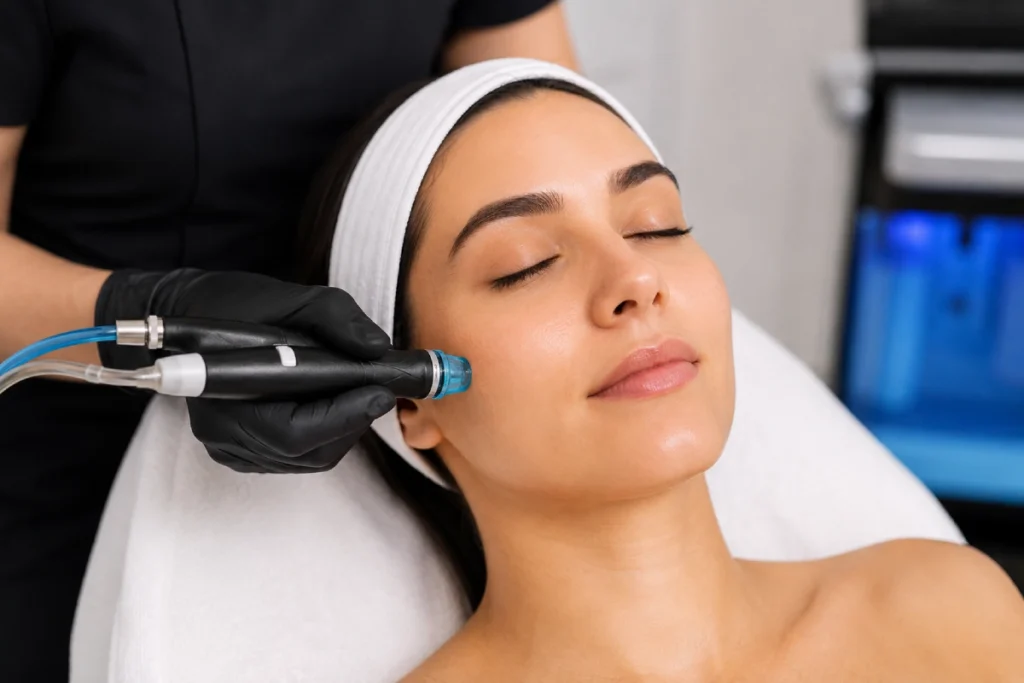
This is one reason HydraFacial has become a popular professional skin treatment. It combines cleansing, exfoliation, extraction and hydration in a single treatment, and the treatment can be customised using different tips, solutions and boosters according to individual skin concerns.
But does that mean HydraFacial is suitable for everyone?
Not necessarily. HydraFacial can be adapted for many skin types, but the right protocol depends on your skin condition, sensitivity and treatment goals. If you have active acne, rosacea, eczema, significant pigmentation or another dermatological condition, a dermatologist should assess your skin before treatment.
This guide explains the potential HydraFacial benefits for different skin types, what the treatment can realistically help with and when another dermatological treatment may be more appropriate.
HydraFacial Benefits at a Glance
HydraFacial is a non-invasive treatment that uses patented Vortex-Fusion® technology to cleanse, exfoliate, extract and hydrate the skin. Depending on the treatment protocol, additional boosters and LED therapy may also be used.
Potential benefits include:
- Smoother-feeling skin
- Improved hydration
- A brighter-looking complexion
- Removal of surface impurities
- Temporary improvement in the appearance of congested pores
- Improved appearance of uneven texture
- Customised treatment for different skin concerns
- Little to no downtime for most people
The results and suitability can vary from person to person. HydraFacial should be considered a cosmetic skin treatment rather than a replacement for medical treatment of an underlying skin condition.
Why Can HydraFacial Be Customised for Different Skin Types?
A traditional facial often follows a relatively fixed sequence of products and techniques.
HydraFacial is different because the treatment can be adjusted through the selection of HydroPeel® tips, exfoliation levels, treatment solutions and targeted boosters. The official HydraFacial platform lists options designed for different needs, including gentle exfoliation for dry or sensitive skin and more intensive exfoliation for dull or oily skin.
This means the same basic treatment platform can be adapted to different skin goals.
However, customisation does not mean that every HydraFacial protocol is appropriate for every person. Your dermatologist or qualified provider should assess your skin before deciding which approach is suitable.
HydraFacial for Oily and Congested Skin
If your skin tends to become oily or congested, you may be interested in HydraFacial because of its extraction and exfoliation steps.
During the treatment, controlled suction helps remove impurities from the pores while the device simultaneously delivers treatment solutions. This can leave congested skin feeling cleaner and smoother.
HydraFacial may therefore be considered for people concerned about:
- Excess surface oil
- Clogged pores
- Blackheads
- Rough texture
- Dull-looking skin
However, HydraFacial should not be considered a standalone treatment for persistent acne.
Acne is a medical skin condition with different forms and causes. If you have recurring inflammatory acne, painful breakouts or acne that is leaving dark marks, a dermatologist can recommend an appropriate treatment plan. The American Academy of Dermatology recommends treating acne according to the type and severity of the condition rather than relying on cosmetic procedures alone.
Can HydraFacial Cause Breakouts?
Some people may notice temporary redness or sensitivity after treatment. A breakout after a facial should not automatically be described as “purging.”
There is limited evidence to support the idea that every breakout following HydraFacial represents normal purging. If you develop persistent or worsening breakouts after treatment, speak with your dermatologist rather than assuming they will resolve on their own.
HydraFacial for Dry and Dehydrated Skin
Dryness and dehydration are not exactly the same thing.
Dry skin generally refers to a skin type with lower oil production, while dehydration refers to a temporary lack of water in the skin.
HydraFacial can be appealing for both because hydration is one of its core treatment steps.
The treatment infuses hydrating and nourishing solutions into the skin after exfoliation and extraction. Depending on the protocol, boosters containing ingredients such as hyaluronic acid can be selected for specific treatment goals.
After treatment, people may notice:
- Softer-feeling skin
- A smoother surface
- Reduced appearance of dryness
- A fresher-looking complexion
- A temporary hydrated glow
If your skin is extremely dry, inflamed or cracked, however, a dermatologist may recommend restoring the skin barrier before undergoing an exfoliating procedure.
HydraFacial for Combination Skin
Combination skin can be difficult to manage because different areas of the face may have different needs.
You may have:
- An oily forehead and nose
- Congested pores around the T-zone
- Normal skin around the cheeks
- Dryness around the mouth
HydraFacial can be customised to address these differences.
For example, the treatment may use a gentler approach in areas that are more sensitive while focusing on cleansing and extraction around areas with greater congestion.
This is one of the practical advantages of having your skin assessed before treatment rather than choosing a standard facial package based only on your general skin type.
HydraFacial for Sensitive Skin
Sensitive skin requires a more cautious approach to any exfoliating treatment.
HydraFacial may be suitable for some people with sensitive skin because treatment intensity and product selection can be adjusted. The official HydraFacial platform includes tips designed for gentle exfoliation and notes that these may be appropriate for first-time clients and dry or sensitive skin types.
However, sensitive skin does not automatically mean HydraFacial is the safest choice.
If you have rosacea, eczema, active irritation, a damaged skin barrier or another inflammatory skin condition, your dermatologist should first determine whether treatment is appropriate.
The goal should be to improve your skin without triggering unnecessary irritation.
For a comparison with chemical peels, read our guide to HydraFacial vs Chemical Peel.
HydraFacial for Acne-Prone Skin
HydraFacial can be considered for some people with acne-prone or congested skin, particularly when the main concern is surface congestion.
There is also published research evaluating a HydraFacial clarifying treatment series in people with active acne vulgaris. A 12-week multicentre study investigated the efficacy and tolerability of the treatment, although this type of evidence should not be interpreted as proof that HydraFacial can replace established medical acne treatments.
If you have mild congestion, your dermatologist may consider HydraFacial as part of a broader skincare plan.
If you have moderate or severe inflammatory acne, cystic acne or acne that is causing scarring, medical acne treatment should take priority.
The American Academy of Dermatology also advises people with darker skin tones to consult a dermatologist before undergoing procedures such as chemical peels, microdermabrasion or laser treatments for acne because inappropriate treatment can cause dark marks or light spots.
HydraFacial for Pigmentation and Uneven Skin Tone
HydraFacial can improve the appearance of dull or uneven-looking skin through exfoliation and hydration.
Some HydraFacial protocols also include targeted boosters for concerns such as uneven tone and dark spots.
However, HydraFacial should not be presented as a universal treatment for pigmentation.
Dark spots can have several causes, including:
- Post-inflammatory hyperpigmentation
- Melasma
- Sun-related pigmentation
- Acne marks
- Other pigmentary disorders
These conditions can require very different treatments.
If pigmentation is persistent, spreading or repeatedly returning, a dermatologist should identify the cause before recommending a procedure.
This is particularly important for Indian skin, where post-inflammatory pigmentation can be a significant concern after skin inflammation or injury.
HydraFacial for Early Signs of Ageing
HydraFacial can be used as part of a cosmetic skin-maintenance routine for people concerned about dullness, uneven texture and the appearance of fine lines.
The treatment can be customised with boosters containing ingredients such as peptides and other targeted formulations, while some treatment protocols also include LED light therapy.
It is important, however, to distinguish between improving the appearance of fine lines and skin texture and actually reversing the biological ageing process.
HydraFacial is not a replacement for treatments specifically designed to address significant skin laxity, deeper wrinkles or substantial volume loss.
A dermatologist can help determine whether HydraFacial is sufficient for your goals or whether another treatment would provide a better result.
HydraFacial for Mature Skin
Mature skin often has several concerns at the same time, including dryness, uneven texture, dullness and visible fine lines.
HydraFacial may help improve some of these surface-level concerns by combining exfoliation and hydration.
For more significant ageing concerns, however, your dermatologist may recommend combining skincare with other evidence-based treatments.
The important point is that HydraFacial does not need to be viewed as an “anti-ageing cure.” It can simply be one component of a broader skin-health plan.
What Results Can You Expect With HydraFacial?
Results vary according to your skin type, treatment protocol and the concern being addressed.
After a treatment, some people notice:
- A brighter-looking complexion
- Smoother-feeling skin
- Improved hydration
- Reduced appearance of surface congestion
- A temporary healthy-looking glow
These immediate cosmetic improvements should not be confused with permanent changes to the skin.
If your goal is to treat acne, pigmentation, acne scars or significant signs of ageing, you may need a different or additional treatment.
Consistency can be useful for people who choose HydraFacial as part of a maintenance routine, but the appropriate treatment interval should be decided according to your skin rather than following a fixed schedule.
HydraFacial Benefits by Skin Type
| Skin type or concern | Potential HydraFacial benefit |
| Oily or congested | Cleansing, exfoliation and extraction |
| Dry or dehydrated | Hydration and smoother-feeling skin |
| Combination | Customised treatment for different areas |
| Sensitive | Gentle, customised exfoliation when appropriate |
| Acne-prone | Surface congestion management |
| Uneven tone | Brighter-looking, more refreshed skin |
| Mature skin | Improved hydration and surface texture |
These are general considerations rather than guarantees. Your skin condition should determine whether HydraFacial is appropriate.
Is HydraFacial Suitable for Every Skin Type?
HydraFacial is designed to be customisable and can be used across a wide range of skin types and concerns.
But “suitable for every skin type” does not mean “suitable for every skin condition.”
You should speak with a dermatologist before treatment if you have:
- Active skin infection
- Significant inflammation
- Severe or uncontrolled acne
- Rosacea or eczema flare-up
- Open wounds
- Severe skin sensitivity
- Recent laser treatment or chemical peel
- Significant pigmentation concerns
A skin consultation is especially important if you are already using prescription skincare or undergoing another dermatological treatment.
Beyond the Face: Can HydraFacial Be Used on the Scalp or Body?
The HydraFacial platform has also been adapted for treatments beyond the face.
For example, HydraFacial Keravive is a specialised scalp treatment designed to cleanse and exfoliate the scalp while delivering selected ingredients.
If scalp health is your concern, read our guide to HydraFacial Keravive for the Scalp.
HydraFacial technology can also be used for selected body areas with specialised tips and protocols. The appropriate area and treatment should be determined by a qualified provider.
How to Get the Most From Your HydraFacial
A professional treatment works best when it is supported by good everyday skincare.
After treatment, your provider may recommend:
- Gentle cleansing
- Regular moisturisation
- Broad-spectrum sunscreen
- Avoiding unnecessary exfoliation
- Following your personalised post-treatment instructions
Do not assume that adding more active products will produce better results.
If your skin is already sensitive or irritated, layering multiple exfoliating products immediately after a treatment may make the problem worse.
The best long-term approach is usually consistency, appropriate skincare and treatments selected according to your actual skin needs.
HydraFacial at Isaac Luxe
At Isaac Luxe, we believe that the treatment should be selected after understanding the skin, not simply because a particular facial is trending.
Our dermatologist-led approach considers your skin type, current concerns, sensitivity, medical history and treatment goals before determining the appropriate HydraFacial protocol.
Depending on your skin, this may involve different exfoliation levels, treatment solutions or targeted boosters.
If HydraFacial is not the right option for your concern, your dermatologist can also recommend another evidence-based treatment.
Isaac Luxe offers dermatology and aesthetic treatments across Delhi NCR, Gurgaon, Mumbai, Bangalore, Hyderabad and Mohali, Punjab.
Explore HydraFacial MD Treatment at Isaac Luxe
Frequently Asked Questions
Is HydraFacial good for oily skin?
HydraFacial may be useful for oily or congested skin because its treatment includes exfoliation and controlled extraction. However, persistent acne or excessive oil production may require a dermatologist-directed treatment plan.
Is HydraFacial suitable for dry skin?
Yes, HydraFacial can be customised for dry or dehydrated skin, with hydration being one of its core treatment steps. However, severely irritated or damaged skin may need to recover before undergoing exfoliation.
Is HydraFacial good for sensitive skin?
It may be suitable for some people with sensitive skin because the treatment can be customised for gentler exfoliation. However, people with active rosacea, eczema, significant irritation or a damaged skin barrier should consult a dermatologist first.
Can HydraFacial help with acne?
HydraFacial may help with surface congestion and has been studied as a treatment for acne vulgaris. However, it should not replace medical acne treatment, particularly for persistent, inflammatory or severe acne.
Can HydraFacial remove pigmentation?
HydraFacial may improve the appearance of dull or uneven skin, but it is not a universal treatment for pigmentation. Melasma, post-acne marks and other pigmentation conditions require different approaches and should be diagnosed before treatment.
Can HydraFacial make pores smaller?
HydraFacial may temporarily improve the appearance of pores by removing surface oil and impurities and improving skin texture. It cannot permanently close or eliminate pores.
Does HydraFacial help with wrinkles?
HydraFacial can improve hydration and the appearance of skin texture and fine lines. More significant wrinkles and skin laxity may require other dermatological treatments.
Can HydraFacial cause breakouts?
Temporary redness or sensitivity can occur after treatment. If you develop persistent or worsening acne after a session, speak with your dermatologist rather than assuming that it is normal “purging.”
How often should I get a HydraFacial?
There is no single schedule that is right for everyone. Treatment frequency should depend on your skin type, concerns, sensitivity and overall skincare plan. Your dermatologist can recommend an appropriate interval.
Sources and References
- HydraFacial Official, Treatment Information
Information on Vortex-Fusion® technology, treatment customisation, exfoliation, extraction, hydration and boosters. - HydraFacial Official, Frequently Asked Questions
Information on treatment steps, skin concerns and customisation. - Storgard R, et al. Efficacy and Tolerability of HydraFacial Clarifying Treatment Series in the Treatment of Active Acne Vulgaris
Published clinical research evaluating a HydraFacial clarifying treatment series for acne vulgaris. - American Academy of Dermatology, Acne Guidelines and Resources
Guidance on evidence-based acne management and the importance of treatment based on acne type and severity. - American Academy of Dermatology, Acne in Skin of Color
Guidance on the risks and considerations associated with procedures such as chemical peels, microdermabrasion and laser treatment in darker skin tones.
Medical disclaimer: This article is intended for general educational purposes and does not replace an in-person consultation with a qualified dermatologist. A dermatologist should assess your skin, medical history and treatment goals before recommending a cosmetic or dermatological procedure.