
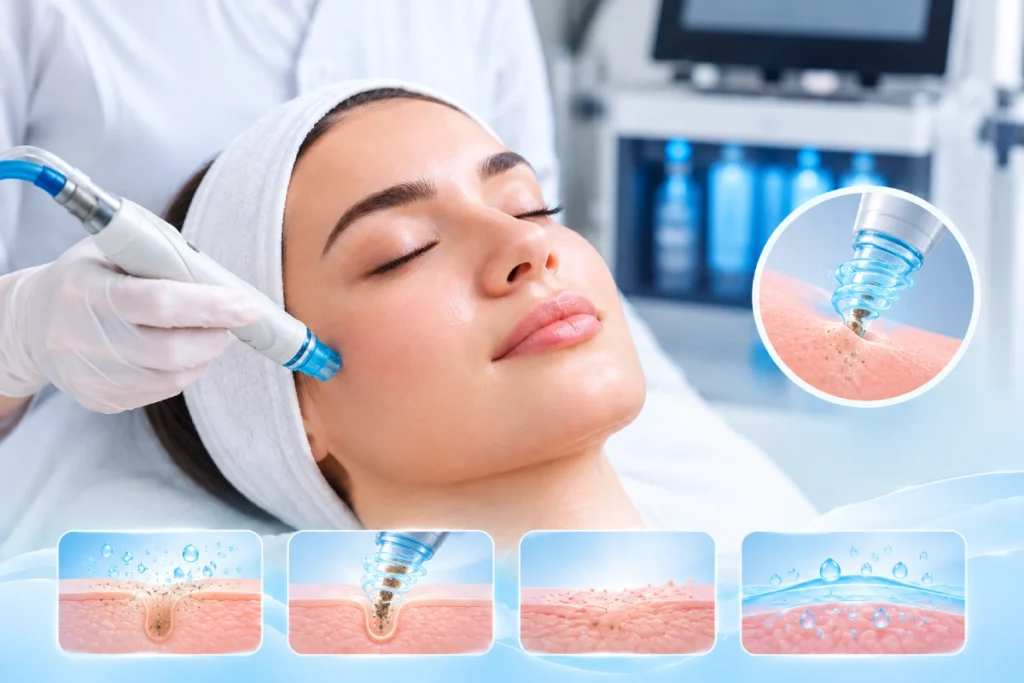
If your skin often looks dull, feels congested or simply seems to have lost its usual freshness, you may have come across HydraFacial while looking for professional skincare treatments.
But what exactly is a HydraFacial? Is it just another facial, does it actually help your skin, and is it suitable for everyone?
A HydraFacial is a non-invasive professional skin treatment that combines cleansing, exfoliation, pore extraction and hydration in a single treatment. It uses a specialised device with Vortex-Fusion® technology to loosen and remove surface impurities while delivering selected skincare solutions to the skin. The treatment can also be customised with boosters or other add-ons depending on your skin concerns.
For someone considering the treatment for the first time, the important question is not simply whether HydraFacial is popular. It is whether it is appropriate for your skin, your concerns and your treatment goals.
This guide explains how HydraFacial works, what happens during a session, what results you can realistically expect, who may benefit from it, and when you should speak to a dermatologist before booking.
HydraFacial at a Glance
In simple terms: HydraFacial is a device-based facial treatment that cleanses, exfoliates, extracts impurities from pores and hydrates the skin during the same session.
It is generally chosen by people who want to improve the appearance of:
- Dull or tired-looking skin
- Dehydrated skin
- Uneven skin texture
- Congested or clogged pores
- Excess surface oil
- Mild unevenness in skin tone
- Fine lines and early signs of ageing
The treatment is designed to be gentle and requires little to no downtime for most people. However, the exact treatment protocol, products used and suitability should be decided according to the individual’s skin.
Important: HydraFacial is primarily a cosmetic skin-refreshing treatment. It should not be considered a replacement for medical treatment of conditions such as moderate-to-severe acne, significant pigmentation disorders or established acne scars.
What is HydraFacial?
HydraFacial is a branded, non-invasive skin treatment that uses a specialised device to perform several skincare steps during one appointment.
The treatment combines:
- Cleansing
- Exfoliation
- Extraction
- Hydration
- Targeted skincare solutions, depending on the treatment plan
One of the defining features of HydraFacial is its Vortex-Fusion® technology. The device uses controlled suction and specialised tips to exfoliate the skin and help remove impurities while simultaneously delivering treatment solutions.
You may also hear HydraFacial described as a form of hydradermabrasion because it combines exfoliation with the delivery of hydrating solutions.
Unlike a traditional facial, where most of the treatment is performed manually, HydraFacial uses a specialised device and a defined treatment system. That makes the procedure more consistent from one session to another.
The treatment can also be personalised depending on whether your main concern is dryness, congestion, dullness, uneven texture or early signs of ageing.
How Does HydraFacial Work?
The easiest way to understand HydraFacial is to look at what happens to the skin during the treatment.
The exact protocol can vary depending on the device, products and treatment level selected, but the core process involves cleansing, exfoliation, extraction and hydration.
Step 1: Cleansing and Exfoliation
The skin is first cleansed and prepared for treatment.
A specialised tip gently exfoliates the surface of the skin, helping remove dead skin cells and surface buildup. This can leave the skin feeling smoother and looking brighter.
The exfoliation is controlled rather than being the same as an aggressive resurfacing procedure.
Step 2: Pore Extraction
The device uses controlled suction to help loosen and remove oil, dirt and other impurities from congested pores.
This is one reason people often choose HydraFacial when their skin feels oily or congested.
Unlike manually squeezing blackheads or pimples at home, the extraction is performed using the treatment device. That said, HydraFacial should not be viewed as a treatment for every type of acne.
If you have active, inflamed or persistent acne, a dermatologist should first determine what is causing the breakouts and whether a HydraFacial is appropriate alongside your medical treatment.
Step 3: Hydration and Serum Infusion
After exfoliation and extraction, hydrating and nourishing solutions are applied to the skin.
Depending on the protocol, ingredients may include hydrating agents such as hyaluronic acid and other selected ingredients.
The goal is to leave the skin feeling hydrated, smoother and more comfortable after treatment.
Step 4: Boosters and Add-On Treatments
Some HydraFacial protocols can be customised with targeted boosters or additional technologies.
These may be selected according to concerns such as:
- Dehydration
- Uneven skin tone
- Congestion
- Fine lines
- Dullness
- Visible signs of ageing
The official HydraFacial treatment platform also includes optional features such as LED light therapy and lymphatic drainage depending on the treatment level and device being used.
Not every patient needs every add-on. A dermatologist should recommend these based on your skin rather than simply adding multiple steps to a treatment.
What Happens During a HydraFacial Treatment?
For a first-time patient, the process is usually straightforward.
Before Your HydraFacial
Your skin should be assessed before treatment, particularly if you have an active skin condition or are using prescription skincare.
Tell your dermatologist about:
- Current acne or skin inflammation
- Sensitive or reactive skin
- Cold sore history
- Recent chemical peels, lasers or other procedures
- Prescription acne treatments
- Any medications that may affect your skin
- Recent sun exposure or sunburn
A professional assessment helps determine whether HydraFacial is suitable and whether the treatment needs to be modified.
During the treatment
You will generally lie comfortably while the device is moved across different areas of the face.
You may feel:
- Gentle suction
- A light exfoliating sensation
- Cool or wet sensations from the treatment solutions
- Mild pressure around areas being treated
Most people find the treatment comfortable. Unlike microneedling or injectable treatments, HydraFacial does not involve needles.
A typical treatment can be completed in around 30 minutes, although the total appointment time can be longer when consultation, customised boosters or additional steps are included. The official HydraFacial platform states that treatments can be performed in as little as 30 minutes.
What Does HydraFacial Feel Like?
HydraFacial is generally described as a comfortable treatment.
The most noticeable sensation is usually the suction from the device as it moves over the skin. During exfoliation, you may feel a gentle polishing sensation.
It should not feel like your skin is being aggressively scrubbed.
There is also no injection or cutting involved.
Some people experience temporary mild redness or sensitivity after treatment, particularly if their skin is sensitive or if a more intensive protocol has been used.
If you experience significant discomfort during a treatment, tell the practitioner immediately.
What are the Benefits of HydraFacial?
HydraFacial is primarily used to improve the appearance and feel of the skin, rather than to treat a single medical skin condition.
Potential benefits include:
1. Brighter-looking skin
Removing surface buildup and dead skin cells can make the skin appear fresher and more radiant immediately after treatment.
2. Improved hydration
The hydration stage can leave the skin feeling softer and more moisturised, particularly if your skin is dehydrated.
3. Smoother skin texture
Exfoliation can temporarily improve the feel and appearance of rough or uneven surface texture.
4. Cleaner-looking pores
The extraction step can help remove surface oil and impurities from congested pores.
5. A temporary glow
The combination of exfoliation, extraction and hydration is why many people notice a smoother, fresher-looking complexion immediately after treatment.
6. Customisation
One of the advantages of the HydraFacial platform is that the treatment can be adjusted according to individual skin goals, including hydration, congestion, uneven tone and visible signs of ageing.
However, it is important to keep expectations realistic. A HydraFacial can improve the appearance of the skin, but it cannot permanently change your skin type or replace a medically appropriate treatment plan for an underlying skin condition.
Who is HydraFacial Suitable For?
HydraFacial may be considered for people with different skin types who want to improve the appearance of their skin without significant downtime.
It may be particularly appealing if you have:
Dull or tired-looking skin
If your skin looks lacklustre despite following a regular skincare routine, exfoliation and hydration may provide a temporary improvement in radiance.
Dehydrated skin
People whose skin feels tight, dry or lacking in moisture may benefit from the hydrating component of the treatment.
Congested or oily skin
The extraction step may be useful for people with surface congestion and clogged pores.
However, persistent acne should be evaluated by a dermatologist rather than managed solely through facials.
Uneven skin texture
Gentle exfoliation can help make the skin feel smoother and more refined.
Early signs of ageing
HydraFacial may temporarily improve the appearance of dryness, dullness and fine lines, but more significant ageing concerns may require treatments specifically designed to stimulate collagen or address deeper structural changes.
Can HydraFacial Treat Acne and Acne Scars?
This is where it is important to separate skin maintenance from medical acne treatment.
HydraFacial may be useful for some people with congestion or blemish-prone skin because the treatment includes exfoliation and extraction.
However, active acne can have different causes and levels of severity. Persistent inflammatory acne may require prescription medication or other dermatologist-directed
treatments. The American Academy of Dermatology recommends an individualised treatment approach for acne rather than relying on cosmetic procedures alone.
HydraFacial also should not be presented as a treatment that removes established acne scars.
Different acne scars require different approaches. Depending on the type and severity of scarring, dermatologists may consider treatments such as microneedling, laser procedures, chemical peels, subcision or other scar-specific treatments.
If acne or acne scarring is your primary concern, a dermatologist can help determine whether HydraFacial has a role in your overall treatment plan.
HydraFacial for Pigmentation: Does It Work?
HydraFacial can help the skin look brighter and more even after exfoliation and hydration, but pigmentation needs to be approached carefully.
Dark spots, post-acne marks, melasma and other forms of pigmentation do not all have the same cause.
For example, melasma can be influenced by factors including UV exposure and hormonal changes, and aggressive or inappropriate procedures may sometimes worsen pigmentation.
This is particularly relevant for Indian skin tones, where post-inflammatory hyperpigmentation can be an important consideration.
If pigmentation is your main concern, a dermatologist should first identify the type of pigmentation before recommending a procedure.
HydraFacial may be used as part of a broader skincare plan in selected patients, but it should not be marketed as a universal pigmentation treatment.
HydraFacial vs Regular Facial: What’s the Difference?
Both treatments aim to improve the appearance of the skin, but the way they are performed is different.
| HydraFacial | Traditional Facial |
| Uses a specialised treatment device | Primarily relies on manual techniques |
| Uses controlled suction for extraction | Extraction may be performed manually |
| Combines exfoliation, extraction and hydration | Steps vary significantly by salon or clinic |
| Treatment can be customised using specific solutions and boosters | Products generally depend on the facial protocol |
| Designed to provide a consistent device-based treatment | Experience and results can vary according to the provider and products used |
That does not necessarily mean one is better for everyone.
The right option depends on your skin, your concerns and what you are trying to achieve.
For someone looking for a quick skin refresh, HydraFacial may be appropriate. Someone with acne, melasma, rosacea or another dermatological condition may need a medical evaluation and a more targeted treatment plan.
What Results Can You Expect From HydraFacial?
One of the reasons HydraFacial is popular is that the skin can look fresher immediately after treatment.
You may notice:
- Smoother-feeling skin
- Improved hydration
- A brighter-looking complexion
- Less surface congestion
- A temporary healthy-looking glow
However, results vary from person to person.
Your skin type, current skin condition, treatment protocol, products used and ongoing skincare routine can all influence the outcome.
The immediate glow should also not be confused with a permanent change in skin quality.
For longer-term improvement in concerns such as acne, pigmentation, acne scars or significant signs of ageing, a dermatologist may recommend a different treatment or combine HydraFacial with other evidence-based procedures.
How Long Does a HydraFacial Result Last?
There is no single number of days that applies to everyone.
The immediate post-treatment glow is temporary and gradually fades as the skin returns to its normal cycle.
How long you notice an improvement depends on your skin, lifestyle, skincare routine and the reason you had the treatment in the first place.
Some people choose periodic HydraFacial sessions as part of their skincare maintenance routine. The appropriate frequency should be decided according to your skin rather than following a fixed schedule simply because it is advertised.
Is HydraFacial Safe?
HydraFacial is a non-invasive treatment and is generally well tolerated when performed appropriately.
However, non-invasive does not mean risk-free.
Temporary effects can include mild redness, sensitivity, tightness or irritation. The likelihood of these effects can depend on the intensity of exfoliation, the products used and the individual’s skin sensitivity.
A professional consultation is particularly important if you have sensitive or reactive skin, an active skin condition or are taking prescription medications.
The American Academy of Dermatology similarly recommends discussing your medical history, medications, expected results and potential side effects with a dermatologist before undergoing professional resurfacing treatments.
Who Should Avoid or Postpone HydraFacial?
HydraFacial may not be appropriate at every point in your skincare journey.
Your dermatologist may recommend postponing or modifying treatment if you have:
- An active skin infection
- Open wounds or significant irritation
- A recent sunburn
- Significant active inflammation
- A skin condition that requires medical treatment first
- Recently undergone another aggressive cosmetic procedure
Pregnancy, prescription medications and recent dermatological procedures should also be discussed with your treating dermatologist because the suitability of specific treatment solutions or add-ons can vary.
Do not assume that a treatment is appropriate simply because it is labelled as gentle or non-invasive.
How Should You Prepare for a HydraFacial?
Your clinic should give you personalised pre-treatment instructions, but some general precautions can help.
Before your appointment:
- Tell your dermatologist about your current skincare products.
- Mention any prescription acne or pigmentation medication.
- Inform the clinic about recent peels, lasers, waxing or other procedures.
- Avoid coming in with sunburned or significantly irritated skin.
- Follow any product-specific instructions provided by your clinic.
If you are unsure whether you should stop a prescription product before treatment, ask your dermatologist rather than stopping it on your own.
What Should You Do After a HydraFacial?
After treatment, your skin may look refreshed immediately, but post-treatment care still matters.
Your dermatologist may recommend:
- Gentle cleansing
- Adequate moisturisation
- Avoiding unnecessary irritation
- Daily broad-spectrum sunscreen
- Following any personalised skincare instructions
Sun protection is particularly important when undergoing exfoliating or resurfacing treatments because UV exposure can contribute to pigmentation and skin damage.
If your dermatologist gives you specific post-treatment instructions, follow those rather than relying on a generic skincare routine.
How Often Should You Get a HydraFacial?
There is no universal schedule that is right for every patient.
Some people have HydraFacial occasionally before an event, while others choose periodic treatments as part of a broader skincare maintenance plan.
Your dermatologist can recommend an appropriate interval based on:
- Your skin type
- Your skin sensitivity
- Your primary concern
- The intensity of the treatment
- Your existing skincare routine
- Any other procedures you are undergoing
More frequent treatment is not automatically better.
The aim should be to maintain healthy skin without unnecessarily irritating or over-exfoliating it.
HydraFacial or a Dermatologist-Recommended Treatment?
This is an important distinction.
If your goal is simply to refresh dull, dehydrated or congested-looking skin, HydraFacial may be a suitable option.
But if your main concern is:
- Persistent acne
- Acne scars
- Melasma
- Significant pigmentation
- Rosacea
- Persistent redness
- Deep wrinkles
- Skin laxity
- A changing or suspicious skin lesion
you should start with a dermatologist consultation.
A dermatologist can determine whether HydraFacial is appropriate or whether another treatment would better address the underlying concern.
In some cases, HydraFacial may be used as one component of a larger treatment plan rather than as the primary treatment.
Why Choose a Dermatologist-Led HydraFacial?
The treatment itself is only one part of the experience.
The more important question is whether the provider can correctly assess your skin and choose an appropriate protocol.
Before booking, consider asking:
- Who will assess my skin?
- What device is being used?
- Is the treatment customised to my skin?
- What products or boosters will be applied?
- What results should I realistically expect?
- Are there any reasons I should postpone treatment?
- What should I use before and after the procedure?
- Is HydraFacial actually the best treatment for my concern?
These questions can help you make a more informed decision rather than choosing a treatment based solely on before-and-after photographs or social media trends.
HydraFacial at Isaac Luxe
At Isaac Luxe, HydraFacial treatments are offered as part of a dermatologist-led approach to aesthetic and skin health.
Rather than following exactly the same protocol for every patient, the treatment can be selected and customised according to your skin type, current condition and treatment goals.
Our approach focuses on understanding the skin first and then determining whether HydraFacial is appropriate for you.
Isaac Luxe offers dermatology and aesthetic treatments across multiple locations in India, including Delhi NCR, Gurgaon, Mumbai, Bangalore, Hyderabad and Mohali, Punjab.
Explore HydraFacial at Isaac Luxe
If you are considering HydraFacial for acne, pigmentation, dehydration, dullness or another skin concern, a consultation can help determine whether HydraFacial is suitable or whether another dermatological treatment would be more effective.
Frequently Asked Questions About HydraFacial
Is HydraFacial worth it?
HydraFacial can be worthwhile if your goal is to temporarily improve skin hydration, smoothness, radiance and surface congestion with little downtime. Whether it is worth it for you depends on your skin concerns and expectations.
Is HydraFacial good for all skin types?
HydraFacial can be customised for different skin types, but that does not mean every protocol is suitable for every person. Sensitive, inflamed or medically affected skin should be assessed by a dermatologist before treatment.
Does HydraFacial hurt?
Most people find HydraFacial comfortable. You may feel mild suction and a gentle exfoliating sensation during the procedure. It does not involve needles or injections.
How long does a HydraFacial take?
The treatment can be completed in around 30 minutes in some protocols. The total appointment may take longer when consultation, customisation or additional treatments are included.
How often should I get a HydraFacial?
There is no single schedule that works for everyone. Some people have occasional treatments, while others include them in a regular skincare plan. Your dermatologist can recommend an interval based on your skin and treatment goals.
Can HydraFacial remove acne scars?
No. HydraFacial may improve the overall appearance and texture of the skin, but established acne scars usually require scar-specific treatment. A dermatologist can determine which procedure is appropriate for the type of acne scar you have.
Can HydraFacial treat pigmentation?
It may temporarily improve the appearance of dull or uneven-looking skin, but different pigmentation conditions require different treatments. Melasma, post-acne pigmentation and other dark spots should be diagnosed before choosing a procedure.
Can I wear makeup after HydraFacial?
Your provider will advise you based on your treatment protocol and skin condition. If your skin is sensitive or mildly irritated after treatment, it may be preferable to keep your routine gentle and follow your clinic’s post-treatment instructions.
Is HydraFacial better than a regular facial?
They are different types of treatments. HydraFacial uses a specialised device and a defined multi-step protocol, whereas traditional facials vary considerably in their techniques and products. The better option depends on your skin and your treatment goals.
Can HydraFacial replace my skincare routine?
No. A professional treatment should complement, not replace, a consistent skincare routine. Daily sunscreen, appropriate cleansing, moisturisation and dermatologist-recommended active ingredients remain important for maintaining skin health.
Sources and References
The information in this article has been reviewed against reputable dermatology and treatment-specific sources, including:
- American Academy of Dermatology (AAD) – Information on professional skin resurfacing treatments, microdermabrasion, acne management and patient safety.
- HydraFacial Official – Information on Vortex-Fusion® technology, treatment steps, customisation and device-specific protocols.
- HydraFacial Electronic Instructions for Use (IFU) – Manufacturer-provided device and treatment documentation.This article is intended for general educational purposes and should not replace an in-person consultation with a qualified dermatologist. Treatment suitability, expected results and risks can vary from person to person.