
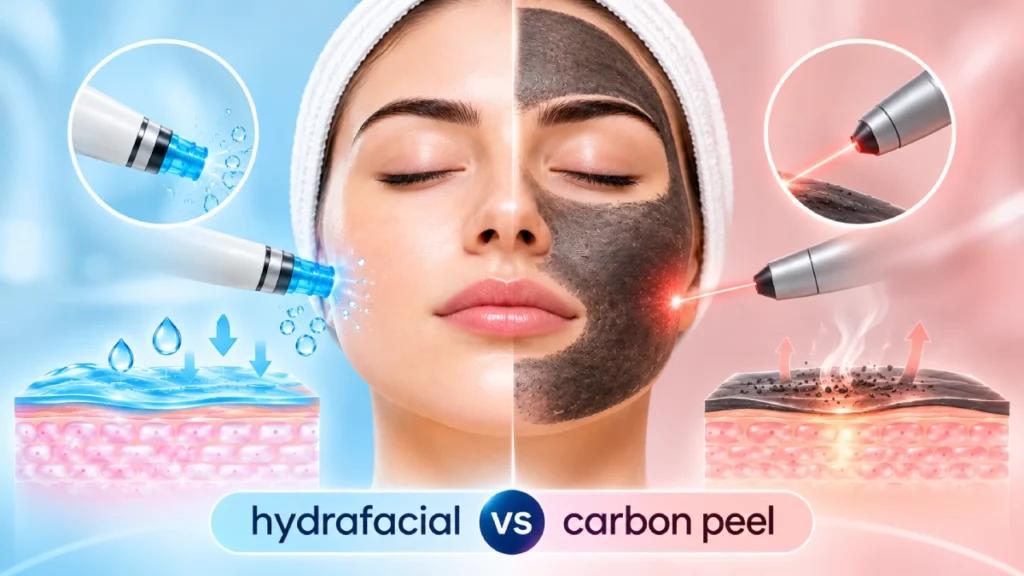
If you are looking for a treatment to make your skin look brighter, smoother or more refreshed, you may have come across two popular options: HydraFacial and carbon peel.
Both are often marketed as treatments for a quick skin refresh, but they are not the same procedure. HydraFacial uses a specialised device to cleanse, exfoliate, extract and hydrate the skin, while a carbon peel combines a topical carbon solution with laser energy.
So, which one should you choose?
The answer depends on your skin and what you want to improve. Someone looking for hydration and gentle exfoliation may benefit from a different approach than someone concerned mainly about oily skin, congestion or acne.
This guide explains the difference between HydraFacial vs carbon peel, what each treatment involves, what concerns they may be suitable for, and why a dermatologist-led assessment is important before choosing either.
HydraFacial vs Carbon Peel: Quick Comparison
| HydraFacial | Carbon Peel | |
| Technology | Vortex-Fusion® device technology | Carbon solution combined with laser energy |
| Main action | Cleansing, exfoliation, extraction and hydration | Carbon-assisted laser exfoliation and heating |
| Common goals | Hydration, radiance, congestion and surface texture | Oiliness, pores, acne and overall skin appearance |
| Laser used? | No | Yes |
| Typical sensation | Gentle suction and gliding | Warmth, snapping or tingling may be felt |
| Downtime | Usually minimal | Usually minimal, but redness or sensitivity can occur |
| Best suited to | Skin refresh, hydration and maintenance | Selected concerns involving oil, pores and acne |
| Evidence | Established branded treatment platform | Evidence is growing but remains more limited |
| Customisation | Tips, solutions and boosters can be customised | Laser settings and carbon protocol can be adjusted |
The important point: neither treatment is universally better. The right choice depends on your skin concern, skin sensitivity, treatment goals and the advice of your dermatologist.
What Is a Carbon Peel?
A carbon peel, also called a carbon laser peel or sometimes a “Hollywood peel,” is a laser-based cosmetic treatment.
During a typical carbon peel, a layer of liquid carbon suspension is applied to the skin. After it sits on the skin for a short period, a laser commonly a Q-switched 1064 nm Nd:YAG laser is used to target the carbon particles. The laser energy interacts with the carbon and helps remove carbon-bound surface debris while also producing a thermal effect in the skin.
The treatment has been studied for concerns including:
- Oily skin
- Enlarged-looking pores
- Acne
- Uneven skin texture
- Dull-looking skin
However, carbon peel should not be presented as a cure for acne or as a permanent pore-tightening treatment. Research on the procedure is still relatively limited, with some published studies involving small patient groups or retrospective data.
This is one reason a dermatologist’s assessment matters when deciding whether a carbon peel is appropriate for you.
What is HydraFacial?
HydraFacial is a non-invasive professional skin treatment that uses patented Vortex-Fusion® technology to cleanse, exfoliate, extract and hydrate the skin in one treatment. It can also be customised using different HydroPeel® tips, boosters and other treatment features depending on the protocol.
Unlike a carbon peel, HydraFacial does not use laser energy.
Instead, the device uses controlled vortex action and suction to exfoliate the skin, remove impurities and deliver selected skincare solutions.
HydraFacial may be considered for concerns such as:
- Dehydration
- Dull-looking skin
- Congestion
- Uneven texture
- Dryness
- Visible signs of ageing
- Clogged pores
If you are new to the treatment, read our guide: What is HydraFacial? A Complete Beginner’s Guide
HydraFacial vs Carbon Peel: How Are They Different?
1. How Do HydraFacial and Carbon Peel Work?
The biggest difference is the technology behind each treatment.
HydraFacial uses mechanical exfoliation, controlled suction and topical solutions. The treatment simultaneously cleanses, exfoliates, extracts and hydrates the skin.
Carbon peel uses a carbon suspension together with laser energy. The laser targets the carbon particles and produces a combination of surface exfoliation and thermal effects.
In other words, HydraFacial is primarily a device-assisted cleansing, exfoliation and hydration treatment, while carbon peel is a laser-based treatment.
2. Which Treatment Feels More Comfortable?
HydraFacial is generally described as comfortable. Most people notice a gentle suction or gliding sensation as the treatment tip moves across the skin.
Carbon peel can feel different because it involves laser energy. Patients may notice warmth, tingling or a snapping sensation during the laser passes.
The experience varies depending on the device settings, treatment protocol and individual sensitivity.
Neither treatment should be expected to cause significant pain. If you experience unexpected or intense discomfort during a procedure, tell the practitioner immediately.
HydraFacial vs Carbon Peel for Different Skin Concerns
The best way to compare the two treatments is to look at the concern you actually want to address.
Which is Better for Hydration and Dry Skin?
If dehydration and dullness are your main concerns, HydraFacial may be the more natural fit.
Its treatment process specifically combines exfoliation with hydration and can be customised with hydrating solutions and boosters.
Carbon peel is not primarily a hydration treatment.
If your skin feels tight, dry or dehydrated, your dermatologist may therefore prefer a treatment approach focused on restoring hydration rather than adding a laser-based procedure.
Which is Better for Oily Skin and Visible Pores?
This is an area where carbon peel may be considered.
The carbon suspension is designed to interact with surface debris and material within follicles, while the laser’s thermal effect may influence sebaceous activity. Studies have reported improvements in acne lesions, pore appearance and overall skin texture, although the available evidence is still limited.
HydraFacial can also help remove surface oil and impurities through its extraction step.
Therefore, if your main concern is oily, congested skin and enlarged-looking pores, a dermatologist may consider either treatment depending on your skin.
It is important to remember that pores cannot be permanently “closed” by a facial treatment. Their appearance can sometimes be reduced temporarily by improving congestion, oil control and skin texture.
Which is Better for Acne?
Neither treatment should replace evidence-based acne treatment when you have persistent or inflammatory acne.
Some studies have reported improvement in acne lesions following carbon peel laser treatment. One prospective study specifically evaluated carbon peel laser in patients with acne and skin of colour, while another retrospective study reported improvements in acne lesions, pores and wrinkles. However, these studies are relatively limited and do not establish carbon peel as a universal acne treatment.
HydraFacial may help with surface congestion and clogged pores, but it is not a substitute for diagnosing and treating the underlying cause of acne.
If you have recurring breakouts, painful acne or acne that is leaving dark marks or scars, start with a dermatologist consultation.
Which is Better for Pigmentation?
This is where you should be particularly careful about choosing a treatment based only on an advertised “glow.”
Pigmentation can have many causes, including post-inflammatory hyperpigmentation, melasma and sun-related pigmentation. The correct treatment depends on the diagnosis.
HydraFacial may temporarily improve the appearance of dull or uneven-looking skin, particularly when exfoliation and appropriate topical solutions are used.
Carbon peel may also improve overall skin appearance, but it should not automatically be considered a pigmentation treatment.
If you have persistent pigmentation or melasma, a dermatologist may recommend a more targeted treatment plan. Chemical peels, topical medications and selected laser or light treatments can have a role in managing certain pigmentary conditions, but treatment needs to be carefully selected.
This is especially important for Indian and other darker skin tones, where procedures that cause skin inflammation can sometimes trigger post-inflammatory pigmentation or other pigmentary changes.
The AAD recommends seeking professional dermatological advice before procedures such as laser therapy or other resurfacing treatments when treating acne or pigmentation in darker skin.
Which Treatment Has Less Downtime?
Both treatments are generally considered relatively low-downtime procedures, but that does not mean everyone will have exactly the same recovery.
With HydraFacial, most patients can return to their usual activities immediately, although temporary redness or sensitivity can occur.
Carbon peel may also have little downtime when performed appropriately, but laser treatment can cause temporary redness, warmth or sensitivity depending on the settings used and the individual’s skin.
Your dermatologist should explain what you can expect before treatment.
If you have an important event coming up, tell your provider in advance. It is better to plan a treatment with a known recovery profile than to try an unfamiliar procedure immediately before an event.
Is HydraFacial Safer Than Carbon Peel?
It would be too simplistic to say that one treatment is always safer.
HydraFacial does not use laser energy and is generally a gentler treatment. Carbon peel, however, can also be performed safely when the appropriate laser, settings and technique are used.
The risk depends on factors including:
- Your skin type
- Skin sensitivity
- Laser settings
- Treatment frequency
- Existing skin conditions
- Recent cosmetic procedures
- Provider experience
This is particularly relevant for people with darker Indian skin tones, where inappropriate laser treatment can increase the risk of unwanted pigmentation changes.
The safety of a procedure depends not just on the technology but on who is performing it and why it has been recommended.
Can You Alternate HydraFacial and Carbon Peel?
Possibly, but there is no universal schedule that everyone should follow.
Someone may choose HydraFacial periodically for hydration and surface maintenance while using carbon peel when a dermatologist believes laser treatment may help with a particular concern.
However, alternating treatments too frequently can unnecessarily irritate the skin.
Your dermatologist should consider:
- Your skin’s tolerance
- The reason for each treatment
- Your current skincare products
- Any active skin condition
- Recent laser or peel treatments
- The interval between procedures
The goal should not be to perform as many treatments as possible. It should be to use the fewest appropriate interventions needed to achieve the desired outcome safely.
HydraFacial vs Carbon Peel Before an Event
If you want a quick skin refresh before an event, HydraFacial may be attractive because it focuses on cleansing, exfoliation and hydration and generally involves minimal recovery.
Carbon peel is also commonly promoted for pre-event brightening, but individual responses vary and laser-based treatment should not be booked for the first time immediately before an important occasion without discussing it with your dermatologist.
Neither treatment should be expected to permanently transform the skin after one session.
HydraFacial vs Carbon Peel: Which One Should You Choose?
A simple way to approach the decision is:
HydraFacial may be worth considering if you want:
- Hydration
- A temporary refreshed appearance
- Gentle exfoliation
- Surface-level congestion management
- Smoother-feeling skin
- Minimal downtime
- A maintenance-oriented treatment
Carbon peel may be considered if your concerns include:
- Oily skin
- Visible pore appearance
- Acne or congestion
- Uneven texture
- A need for a laser-based approach
But these are only general indications.
A dermatologist may recommend a different treatment entirely if your main concern is melasma, significant acne scarring, persistent acne, severe pigmentation or another medical skin condition.
HydraFacial vs Carbon Peel: Which Is Better for You?
There is no universal winner.
HydraFacial may be better suited to someone looking for hydration, gentle exfoliation, congestion management and a temporary skin refresh.
Carbon peel may be considered when oiliness, pore appearance, acne or texture are the main concerns and a dermatologist believes a laser-based treatment is appropriate.
The decision should be based on your skin rather than the promise of an instant “glow.”
If you have a persistent skin concern, getting the diagnosis right is more important than choosing between two popular facial treatments.
Get a Personalised Recommendation at Isaac Luxe
At Isaac Luxe, treatment selection begins with understanding your skin.
Our dermatologist-led consultations consider your skin type, concerns, medical history, sensitivity and treatment goals before recommending an appropriate procedure.
Depending on your needs, that may be HydraFacial, carbon peel, another dermatological treatment or a combination approach.
Isaac Luxe offers dermatology and aesthetic treatments across multiple locations in India, including Delhi NCR, Gurgaon, Mumbai, Bangalore and Hyderabad.
Explore HydraFacial Treatment at Isaac Luxe
Explore Carbon Peel Treatment at Isaac Luxe
Frequently Asked Questions
Which is better, HydraFacial or carbon peel?
Neither treatment is universally better. HydraFacial may be more suitable for hydration, gentle exfoliation, congestion and skin maintenance, while carbon peel may be considered for concerns such as oily skin, visible pores, acne and uneven texture.
Is carbon peel good for glowing skin?
Carbon peel can make the skin appear brighter and smoother after treatment, but the degree and duration of improvement vary. It should not be viewed as a permanent solution for dullness or pigmentation.
Is HydraFacial better for sensitive skin?
HydraFacial is generally a gentler option because it does not use laser energy, but sensitive skin still needs individual assessment. The treatment protocol and products should be adjusted according to your skin’s tolerance.
Is carbon peel painful?
Most people tolerate carbon peel well, although the laser can cause warmth, tingling or a snapping sensation. The exact experience varies with the laser settings and individual sensitivity.
Can carbon peel remove acne?
Carbon peel may help improve some acne-related concerns, and small clinical studies have reported improvements in acne lesions. However, it should not replace dermatologist-directed acne treatment, particularly for persistent or inflammatory acne.
Does carbon peel permanently reduce pores?
No. Pores cannot be permanently closed by a facial treatment. Carbon peel may temporarily improve the appearance of pores by addressing oil, debris and skin texture.
Can HydraFacial and carbon peel be done together?
They may be used as part of a broader treatment plan in selected patients, but they should not be combined or scheduled closely together without professional advice. Your dermatologist should determine whether combining or alternating them is appropriate.
Which is better for pigmentation, HydraFacial or carbon peel?
Neither should automatically be chosen for pigmentation without identifying its cause. Melasma, post-acne pigmentation and sun-related pigmentation may require different treatments. A dermatologist can recommend the appropriate approach after assessing your skin.
Sources and References
- HydraFacial Official – Treatment Information
Information on Vortex-Fusion® technology, exfoliation, extraction, hydration and treatment customisation. - PubMed – Carbon Peeling Laser Treatment to Improve Skin Texture, Pores and Acne Lesions
Research examining carbon peel laser treatment and its potential effects on acne, pores, wrinkles and overall skin appearance. - PubMed – Efficacy of Carbon Peel Laser in Acne Vulgaris in Skin of Color
Prospective study evaluating carbon peel laser treatment in patients with acne and skin of colour. - American Academy of Dermatology – Chemical Peels
Background on professional skin resurfacing, treatment selection and safety considerations. - American Academy of Dermatology – Acne and Skin of Color
Guidance on procedures and treatment considerations for acne in darker skin tones. - American Academy of Dermatology – Melasma Treatment
Information on dermatologist-led treatment options for pigmentation and melasma.
Medical disclaimer: This article is intended for general educational purposes and does not replace an in-person consultation with a qualified dermatologist. A dermatologist should assess your skin, medical history and treatment goals before recommending a cosmetic or dermatological procedure.