
Sometimes, your skin doesn’t need another product it simply needs a fresh start.
Dullness, uneven skin tone, pigmentation, acne marks, and rough texture can slowly affect how we feel about our skin. You may have a carefully planned skincare routine and still feel like your complexion has lost its natural freshness. This is where professional treatments such as chemical peels can offer another approach to skin renewal.
A chemical peel uses a specially formulated solution to exfoliate the skin and remove damaged or dead skin cells from its surface. Depending on the type and depth of the peel, it may help improve several common skin concerns. However, understanding the treatment and choosing the right approach for your skin is just as important as knowing its benefits.
What Is a Chemical Peel?
A chemical peel is a professional skin treatment in which a chemical solution is carefully applied to the skin to encourage controlled exfoliation. As the treated skin gradually sheds, newer skin underneath can appear smoother and more refreshed.
Chemical peels can vary considerably in their ingredients, concentration, and depth. Superficial peels generally work on the outermost layer of the skin, while medium and deep peels penetrate further and require greater recovery.
Because every skin type responds differently, the right peel should be selected according to your skin condition, concerns, sensitivity, and desired outcome.
What Are the Benefits of Chemical Peel for Skin?
The chemical peel benefits can vary depending on the formulation and depth of treatment. When appropriately selected, chemical peels may help address several visible skin concerns.
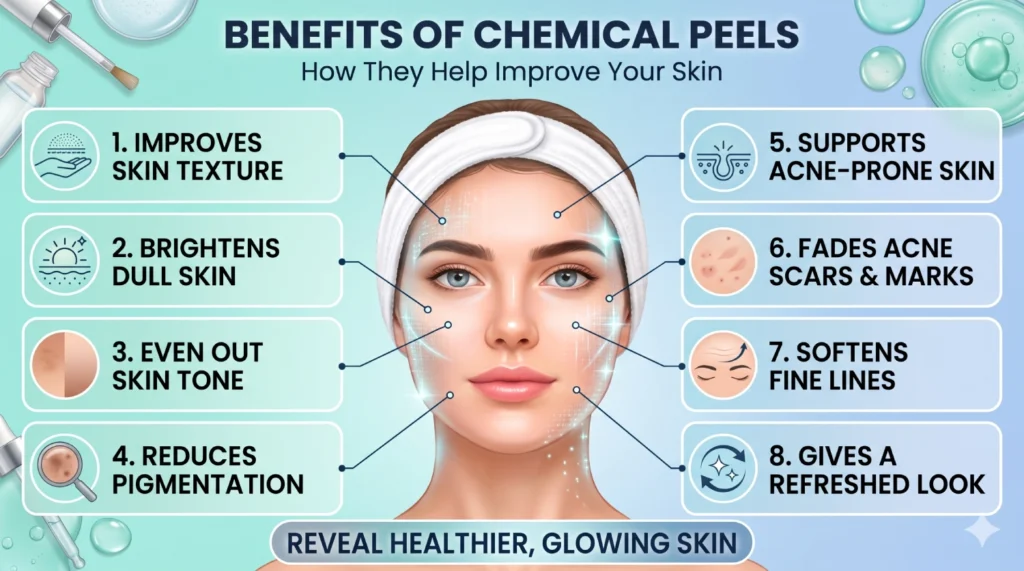
1. Helps Improve Skin Texture
Dead skin cells can accumulate on the surface, leaving skin looking rough or uneven. By encouraging exfoliation, a chemical peel can help create a smoother-looking surface and improve the overall feel of the skin.
2. Brightens Dull-Looking Skin
When dead skin cells build up, the complexion can appear tired or lacklustre. A suitable peel can remove some of this buildup, revealing fresher-looking skin and helping the complexion appear more radiant.
3. Helps Improve Uneven Skin Tone
Uneven-looking skin tone can develop for several reasons, including sun exposure and post-inflammatory changes. Certain chemical peels may help improve the appearance of uneven tone by promoting controlled exfoliation and skin renewal.
4. May Help With Pigmentation
Pigmentation is one of the concerns for which people often explore professional exfoliating treatments. A chemical peel for pigmentation may help reduce the appearance of certain dark spots and areas of uneven pigmentation.
However, pigmentation can have different underlying causes, and not every type responds in the same way. Professional assessment is therefore important before choosing a treatment.
5. Can Support Acne-Prone Skin
Certain chemical peels can be incorporated into skincare approaches for acne-prone skin. By exfoliating dead skin cells and helping address clogged pores, selected formulations may contribute to clearer-looking skin.
However, chemical peels should not be viewed as a universal solution for acne. The appropriate treatment depends on the type and severity of the concern.
6. May Improve the Appearance of Acne Scars and Marks
Acne can leave behind more than memories of breakouts. Persistent marks and changes in skin texture can affect confidence long after the acne itself has settled.
A chemical peel for acne scars may help improve the appearance of certain superficial marks and uneven texture. However, deeper acne scars may require other treatments, and results can vary significantly between individuals.
7. Can Soften the Appearance of Fine Lines
Some chemical peels can improve surface texture and make certain fine lines appear less noticeable. The extent of improvement depends on the type and depth of the peel and the condition of the skin being treated.
8. Gives the Skin a Refreshed Appearance
Perhaps one of the most noticeable advantages is the overall refreshed appearance that can develop as the skin recovers. Smoother texture, improved brightness, and a more even-looking complexion can make the skin feel renewed without changing its natural character.
How Does a Chemical Peel Provide These Benefits?
Chemical peels work through controlled exfoliation. The solution interacts with the outer layers of the skin, helping loosen and remove damaged or dead cells.
Different ingredients and concentrations are designed for different purposes, which is why the strongest peel isn’t necessarily the best peel. A treatment that is appropriate for one person may be too intensive for another.
The goal should always be to select a treatment that is appropriate for the individual’s skin rather than simply choosing the most powerful option available.
What Should You Expect After a Chemical Peel?
Following treatment, the skin may experience temporary redness, sensitivity, dryness, or peeling. The extent of these effects depends largely on the depth of the peel.
As the skin recovers, improvements may gradually become more noticeable. It is important not to rush this process by picking or peeling the skin manually.
Following professional aftercare instructions, keeping the skin moisturised, and protecting it from excessive sun exposure are important parts of the recovery process.
How Often Should You Get a Chemical Peel?
There is no universal schedule for chemical peel treatments. Superficial peels may sometimes be repeated as part of a planned skincare routine, while medium and deeper treatments generally require longer recovery periods.
The ideal frequency depends on factors such as the type of peel, your skin’s response, the concern being treated, and professional recommendations.
Choosing the Right Treatment for Your Skin
With so many skincare treatments available today, it can be tempting to choose a peel based on online trends or someone else’s experience. But what works beautifully for one person’s skin may not be suitable for another.
There are many clinics and aesthetic brands providing chemical peel treatments, including Isaac Luxe. When exploring a professional treatment, the focus should be on understanding your individual skin concerns and selecting an approach that is appropriate for your skin rather than following a one-size-fits-all treatment.
A professional consultation can help assess your skin and determine whether a chemical peel is suitable and, if so, which type may be appropriate.
Chemical Peel Aftercare Matters
The treatment itself is only one part of the process. Proper aftercare can help support the skin while it recovers.
Generally, this means keeping your skincare routine gentle, moisturising regularly, using broad-spectrum sunscreen, and avoiding harsh exfoliants or irritating products until your skin has recovered. Most importantly, follow the specific instructions provided by your skincare professional.
Final Thoughts
Chemical peels can be a useful professional treatment for improving the appearance of concerns such as dullness, uneven texture, pigmentation, acne-related marks, and fine lines. But the best results don’t come from simply choosing the strongest peel they come from choosing the right treatment for your skin.
If you’re considering a chemical peel, take the time to understand your skin, have realistic expectations, and seek professional guidance. After all, healthier-looking skin isn’t about chasing perfection; it’s about feeling comfortable, confident, and cared for in your own skin.
_________________________________________________________________________
Frequently Asked Questions
1. What are the main benefits of a chemical peel?
Chemical peels can help improve the appearance of dullness, uneven skin tone, pigmentation, rough texture, acne-related marks, and fine lines. The benefits vary depending on the peel selected, your skin condition, and the treatment approach.
2. Can a chemical peel make your skin glow?
Absolutely, a suitable chemical peel can give the skin a fresher and more radiant appearance by removing accumulated dead skin cells. The visible effect varies between individuals and depends on the type and depth of treatment.
3. Can a chemical peel help with pigmentation?
Certain chemical peels can help improve the appearance of pigmentation, dark spots, and uneven skin tone. However, pigmentation can have different causes, so professional assessment is important to determine whether a peel is appropriate.
4. Can chemical peels help with acne?
They can, as certain chemical peels may help exfoliate dead skin cells and address clogged pores associated with acne-prone skin. However, treatment suitability depends on the type and severity of acne and should be professionally assessed.
5. Can a chemical peel help with acne scars?
Potentially, certain superficial peels may improve the appearance of mild acne marks and uneven skin texture. Deeper acne scars can be more complex and may require other treatments, so expectations should be discussed with a professional.